
KKHUBII ART FORMS
Celebrating Art Forms That Carry Soul and Story
Our Pillars
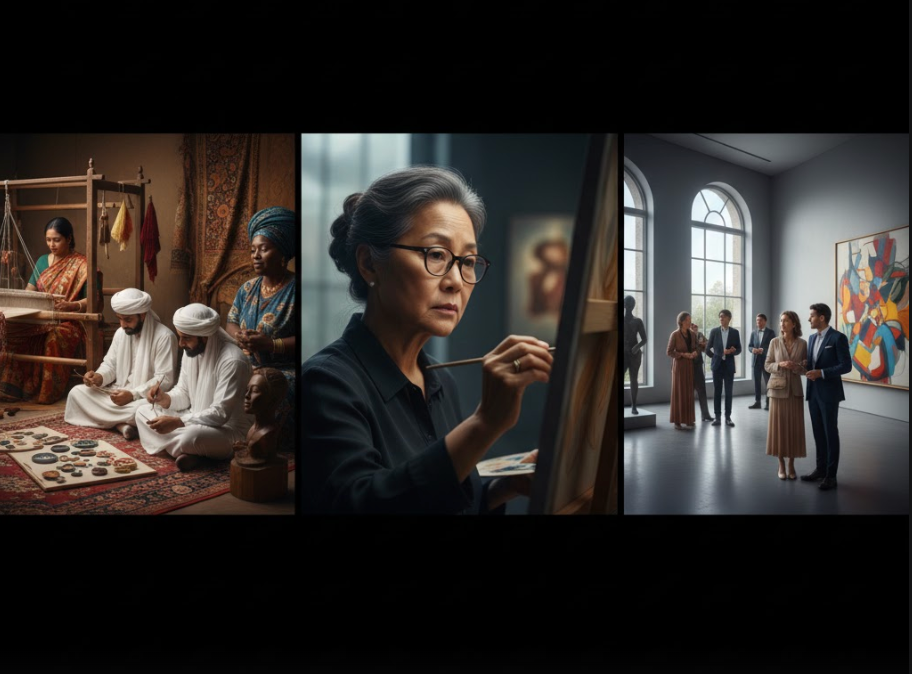
We seek art forms deeply rooted in heritage, tradition, and lived experience expressions that preserve cultural identity while remaining relevant in a contemporary global context.
01 - Cultural Authenticity
Each art form is assessed for mastery, originality, and creative depth, reflecting a high standard of craftsmanship, innovation, and enduring artistic value.
02 - Artistic Excellence
We prioritize art forms that create long-term value empowering artists economically, supporting communities, and offering collectors and partners culturally meaningful and investable creative assets.
03 - Sustainable Impact

The dance is a celebration of rhythm, coordination, and feminine energy, often narrating stories of local heroes, devotion to gods, and communal joy. Dancers move in circular formations, spinning gracefully in layered lehengas adorned with mirrors, bells, and embroidery. The claps and percussion of the performance are not just accompaniment, they become part of the dancer’s body, creating a symphony of movement and sound.
The Performance

Terah Taali is a rare, devotional Rajasthani folk dance performed primarily by women in villages during festivals and religious celebrations. The name literally means “Thirteen Claps”, referencing the rhythmic beats created by wooden claps, sticks, and sometimes small metallic plates.
The Story of Terah Taali

Unlike more famous Rajasthani dances like Ghoomar, Terah Taali remains hidden in villages, making it a living treasure of Rajasthan’s folk heritage. Every step, every clap, is both a ritual offering and a visual poem, preserving culture while resonating with raw human joy and devotion.
A Hidden Treasure

At the heart of Dhrupad lies the tanpura, whose continuous drone creates a sonic foundation, an unbroken resonance that grounds both singer and listener. The opening alap is unmetered and meditative, revealing a raga gradually, as if emerging from silence. The voice is deep, steady, and powerful, shaped by breath rather than ornamentation.
The Sound

Dhrupad is one of India’s oldest surviving forms of classical music a practice of stillness, breath, and devotion. Rooted in ancient temple traditions, it is less about performance and more about immersion, where sound becomes a pathway to inner awareness. Each note unfolds slowly, allowing the listener to feel vibration before melody.
The Story of Dhrupad

Dhrupad treats music as discipline and offering. It demands patience, restraint, and absolute control, transforming sound into a spiritual architecture. In an age of speed and spectacle, Dhrupad endures as a reminder that the most profound expressions often arise from quiet focus and sustained presence.
Music as Devotion

Rajasthani miniatures draw from myth, folklore, and devotion, using bold colors, stylized figures, and rhythmic composition to narrate epics and emotional states. Mughal miniatures, influenced by Persian aesthetics, bring naturalism, portraiture, and architectural depth, capturing historical events and royal presence with remarkable finesse.
The Technique

Miniature painting is an art of intimacy and precision, where entire worlds unfold within the span of a hand. Flourishing in the royal courts of Rajasthan and the Mughal empire, these paintings were created not to overwhelm, but to invite the viewer closer into moments of love, devotion, battle, nature, and everyday courtly life.
The Story of Miniature Painting

Every line is deliberate. Brushes made of a single hair, pigments derived from minerals, plants, and precious stones, and gold used sparingly yet reverently miniature painting is an exercise in patience and mastery. Stories are layered through gesture, gaze, and setting, allowing time to slow and meaning to deepen.
Today, miniature painting endures as a language of detail in an age of scale reminding us that grandeur can exist in the smallest of frames, and that storytelling, when handled with care, becomes timeless.
Grandeur in Miniature

Masks play a central role in Chhau, especially in the Purulia and Seraikella styles. They strip the dancer of personal identity, transforming them into gods, demons, animals, and epic heroes drawn from the Ramayana, Mahabharata, and local folklore. Through these masks, human performers become vessels for myth, channeling cosmic battles between good and evil.
The Mask

The Story of Chhau
Chhau is a dance born at the intersection of war, ritual, and storytelling. Emerging from eastern India: Odisha, Jharkhand, and West Bengal. Tt carries the memory of ancient warriors who trained their bodies through movement, discipline, and rhythm. Unlike classical forms driven by facial expression, Chhau speaks through the body alone leaping, circling, striking the ground with force and precision.

Chhau is both raw and refined its powerful martial movements softened by moments of stillness and grace. Traditionally performed during festivals and communal gatherings, it is not just entertainment but a ritual offering, a way for communities to remember their stories, honor their ancestors, and embody courage, devotion, and transformation.
Today, Chhau stands as a living art form grounded in soil and sweat, yet resonating far beyond its villages where every leap is resistance against forgetting, and every mask carries centuries of collective memory.